Boxing Weight Classes 2026: WBC, WBA, IBF & WBO (kg & lb)

By Simon Jounan · Founder of MyFightPrep · Kickboxer & Muay Thai fighter
Published · 8 min read
All pro boxing weight classes in kg and lb, how the WBC, WBA, IBF and WBO name them, women's divisions, bridgerweight and each body's weigh-in rules.
Contents
Professional boxing has 17 weight classes at the WBA, IBF and WBO, running from 105 lb to heavyweight above 200 lb. The WBC has 18: it keeps bridgerweight (up to 224 lb) and starts heavyweight only above 224 lb. The limits are the same across the four bodies, but the names aren’t, women’s divisions start at 102 lb, and each body runs its weigh-ins differently. All of it is below in kg and lb.
Limits checked: October 2026 — confirm with your bout agreement and the local commission.
The four major sanctioning bodies
A world title in boxing comes from a sanctioning body, not from a league. Four are recognised as major:
- WBC (World Boxing Council)
- WBA (World Boxing Association)
- IBF (International Boxing Federation)
- WBO (World Boxing Organization)
Each one keeps its own rankings and champions. A fighter who holds all four belts in a division is the undisputed champion. The weight limits themselves come from the pound-based ladder that all four share. What differs is the naming, the women’s divisions, bridgerweight and the weigh-in rules.
Amateur and Olympic boxing is a separate system with limits in whole kilograms. See amateur boxing weight classes for those.
Men’s boxing weight classes (all four bodies)
The table shows each limit in lb and kg and what each body calls it. Sources: WBC ratings pages (updated 2 October 2026), WBA ratings for September 2026, IBF championship rules (rule 1) and WBO championship regulations (section 3) (WBC, 2026; WBA, 2026; IBF, 2025; WBO).
| Limit (lb) | Limit (kg) | WBC | WBA | IBF | WBO |
|---|---|---|---|---|---|
| 105 lb | 47.6 kg | Strawweight | Minimumweight | Mini flyweight | Mini flyweight |
| 108 lb | 49.0 kg | Light flyweight | Light flyweight | Jr. flyweight | Jr. flyweight |
| 112 lb | 50.8 kg | Flyweight | Flyweight | Flyweight | Flyweight |
| 115 lb | 52.2 kg | Super flyweight | Super flyweight | Jr. bantamweight | Jr. bantamweight |
| 118 lb | 53.5 kg | Bantamweight | Bantamweight | Bantamweight | Bantamweight |
| 122 lb | 55.3 kg | Super bantamweight | Super bantamweight | Jr. featherweight | Jr. featherweight |
| 126 lb | 57.2 kg | Featherweight | Featherweight | Featherweight | Featherweight |
| 130 lb | 59.0 kg | Super featherweight | Super featherweight | Jr. lightweight | Jr. lightweight |
| 135 lb | 61.2 kg | Lightweight | Lightweight | Lightweight | Lightweight |
| 140 lb | 63.5 kg | Super lightweight | Super lightweight | Jr. welterweight | Jr. welterweight |
| 147 lb | 66.7 kg | Welterweight | Welterweight | Welterweight | Welterweight |
| 154 lb | 69.9 kg | Super welterweight | Super welterweight | Jr. middleweight | Jr. middleweight |
| 160 lb | 72.6 kg | Middleweight | Middleweight | Middleweight | Middleweight |
| 168 lb | 76.2 kg | Super middleweight | Super middleweight | Super middleweight | Super middleweight |
| 175 lb | 79.4 kg | Light heavyweight | Light heavyweight | Light heavyweight | Light heavyweight |
| 200 lb | 90.7 kg | Cruiserweight | Cruiserweight | Cruiserweight | Jr. heavyweight |
| 224 lb | 101.6 kg | Bridgerweight | — | — | — |
| No limit | No limit | Heavyweight (over 224 lb) | Heavyweight (over 200 lb) | Heavyweight (over 200 lb) | Heavyweight (over 200 lb) |
Two naming traps catch people out. The 105 lb class has three names: the WBC now calls it strawweight, the WBA minimumweight, and the IBF and WBO mini flyweight. And the 200 lb class is cruiserweight everywhere except the WBO, which calls it junior heavyweight.
Bridgerweight: WBC only since June 2026
The WBC created bridgerweight for boxers between 200 and 224 lb, and the WBA later added its own version. The WBA then eliminated the division effective 30 June 2026 and moved its two bridgerweight champions into the cruiserweight and heavyweight rankings (WBA, 2026).
That leaves the WBC as the only major body with the class. Its ratings list bridgerweight at 224 lb (101.6 kg) and heavyweight above 224 lb (WBC, 2026). At the WBA, IBF and WBO, anyone over 200 lb is a heavyweight.
Women’s boxing weight classes
Women box from 102 lb (46.3 kg) upwards with all four bodies, which is one class lighter than the men’s ladder. From 102 to 168 lb the limits match across the board. Above that, each body stops at a different point:
| Limit | WBC | WBA | IBF | WBO |
|---|---|---|---|---|
| 102 lb / 46.3 kg | Atomweight | Light minimumweight | Jr. mini flyweight | Atomweight |
| 105–168 lb | Same ladder as the men | Same ladder as the men | Same ladder as the men | Same ladder as the men |
| 175 lb / 79.4 kg | — | Light heavyweight | Light heavyweight | — |
| 200 lb / 90.7 kg | — | — | Cruiserweight | — |
| Heavyweight | Over 168 lb | Over 175 lb | Over 200 lb | Next class after 168 lb* |
These come from each body’s current women’s ratings and champion lists: the WBC’s ratings pages, the WBA’s September 2026 female ratings and rules, the IBF’s champions list and the WBO’s female ratings of 28 September 2026 (WBC, 2026; WBA, 2026; IBF, 2026; WBO, 2026). Names follow the same pattern as the men’s: the WBC and WBA say “super”, the IBF and WBO say “junior”.
*The WBO’s female ratings go straight from super middleweight (168 lb) to heavyweight, which they label “over 201 lb”. No WBO women’s class covers 168–201 lb, so check with the WBO if you box at that weight.
How pro boxing weigh-ins work
All four bodies weigh you in the day before the fight, which gives you time to recover. The details differ:
| WBC | WBA | IBF | WBO | |
|---|---|---|---|---|
| Official weigh-in | 24–30 hours before the event | 16–36 hours before the bout | 20–30 hours before the first bout | No fixed window in its regulations |
| Time to make weight | 2 hours, as many attempts as you like | 2 extra hours | 2 hours | 2 hours |
| Extra checks | Safety weigh-ins 30, 14 and 7 days out, plus a day-of-bout weigh-in | — | Second-day weigh-in on fight morning | — |
WBC. For title fights and eliminators, you must be within 10% of the limit 30 days out, 5% at 14 days and 3% at 7 days (rule 4.14). A day-of-the-bout weigh-in under the WBC Weight Management Program follows on fight day, and the WBC’s championship rules prohibit IV rehydration at any time (WBC, 2026; WBC Rules).
WBA. The official weigh-in and rules review take place 16–36 hours before the bout. If you miss, you get two more hours. A champion who makes weight keeps the title against a challenger who doesn’t, even if the champion loses (WBA Rules, 2024).
IBF. After the official weigh-in, IBF title fights have a second-day weigh-in between 8 and 10 a.m. on fight day. The ceiling isn’t a flat 10 lb, as is often said. It grows with the division:
| Division limit | Fight-morning ceiling | Allowed gain |
|---|---|---|
| 105–140 lb | Limit + 10 lb (e.g. 145 lb for 135) | 10 lb (4.5 kg) |
| 147 lb | 158 lb | 11 lb |
| 154 lb | 165 lb | 11 lb |
| 160 lb | 172 lb | 12 lb |
| 168 lb | 180 lb | 12 lb |
| 175 lb | 188 lb | 13 lb |
| 200 lb | 214 lb | 14 lb |
The second-day weigh-in is waived for heavyweight championships and unification bouts. A champion who’s over the ceiling after two more hours loses the title on the scale (IBF, 2025).
WBO. If you miss the official weigh-in, you get two hours to make weight. A champion who still misses loses the title at the scales (WBO).
Local commissions run the scale, and their rules apply on top of the sanctioning body’s. The International Society of Sports Nutrition groups professional boxing with the sports that weigh in 24–36 hours before competition (Ricci et al., 2025). For how to use that window, see our guide to rehydrating after the weigh-in.
Where do common weights land?
Each weight here is your weigh-in number, not your walking weight. Names are WBC / IBF where they differ.
| Weigh-in weight | Class | Limit |
|---|---|---|
| 60 kg / 132.3 lb | Lightweight | 135 lb / 61.2 kg |
| 63.5 kg / 140 lb | Super lightweight / Jr. welterweight | 140 lb / 63.5 kg |
| 70 kg / 154.3 lb | Middleweight (just over 154) | 160 lb / 72.6 kg |
| 75 kg / 165.3 lb | Super middleweight | 168 lb / 76.2 kg |
| 80 kg / 176.4 lb | Cruiserweight (just over 175) | 200 lb / 90.7 kg |
| 95 kg / 209.4 lb | WBC bridgerweight, otherwise heavyweight | 224 lb / 101.6 kg (WBC) |
How to choose your boxing weight class
Choose the class you can make mostly through fat loss in camp, with only a small cut in fight week. A practical way to do it:
- Find your lean training weight. Weigh yourself every morning for two weeks under the same conditions and use the average.
- Check the distance to the limit. The ISSN suggests that staying about 12–15% above your class between camps may be the upper limit for a suitable weight descent, and that 0.5–1 kg (1.1–2.2 lb) a week is the usual rate of loss during camp (Ricci et al., 2025).
- Keep the water cut small. The ISSN puts the optimal acute water loss at around 2–4% of body mass within 24 hours of the weigh-in, with appropriate supervision (Ricci et al., 2025). In WBC title fights below heavyweight, the 7-day check already caps you at 3% over the limit.
- Set a minimum competition weight. The ACSM consensus statement recommends basing it on body composition measured before the season and banning unhealthy weight-loss methods (Burke et al., 2021).
- Move up if the numbers don’t fit. Below welterweight, the next class up is only 3–5 lb heavier, and losing less weight costs far less than a drained fight night.
Want your own numbers? The weight cut calculator shows the weekly pace you’d need and what’s left for fight week. For the method behind it, read how much weight you can safely cut and how to cut weight for a fight. If you cross-train, compare these with Muay Thai and kickboxing weight classes, or see the overview of combat sports weight classes.
MyFightPrep tracks your weight trend toward the class limit and fight date, so you know early whether a class is realistic — free during the beta.
Important
This guide is general information, not medical advice. Weight classes, names and weigh-in rules change, so always check your bout agreement, the sanctioning body’s current rules and the local commission. Rapid dehydration can be dangerous. Never use diuretics, laxatives, vomiting or heavy sweat suits to make weight. Stop and get help if you feel dizzy, confused, faint or develop cramps. Young and inexperienced boxers should cut little or no water weight and should choose their class with a coach and a doctor.
Use this chart on your site
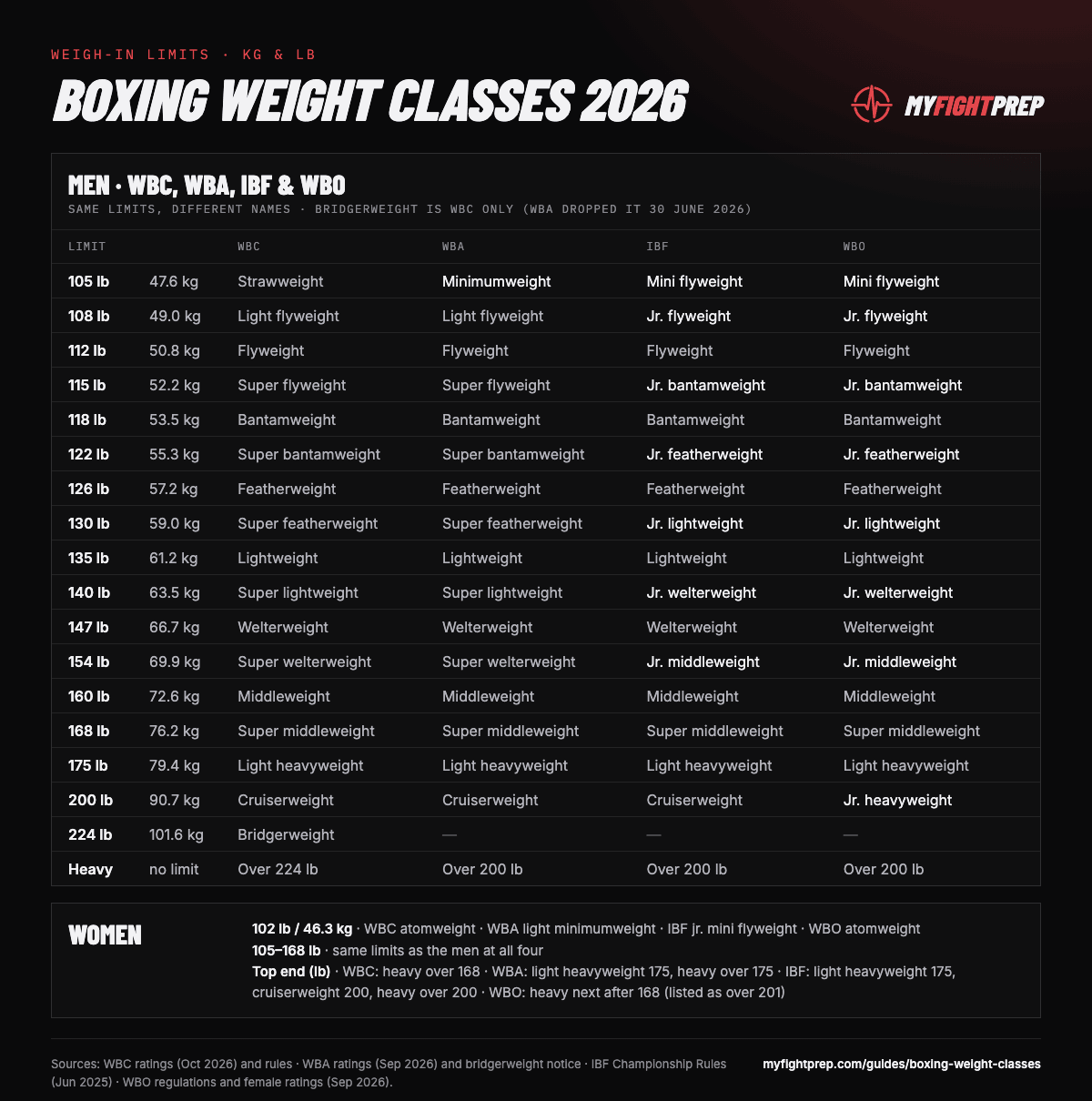
All the pro limits and the names each sanctioning body uses, on one image in kg and lb. Download it, print it for the gym wall, or paste the code below to embed it with a link back to this page.
Frequently asked questions
How many weight classes are there in boxing?
Men's professional boxing has 17 weight classes at the WBA, IBF and WBO, from 105 lb to heavyweight over 200 lb. The WBC has 18, because it adds bridgerweight (up to 224 lb) and starts heavyweight above 224 lb. Women's divisions start at 102 lb, and the top classes differ by sanctioning body.
What are the boxing weight classes in order?
From lightest: 105 lb (strawweight/minimumweight), 108, 112, 115, 118, 122, 126, 130, 135, 140, 147, 154, 160, 168, 175, 200 (cruiserweight) and heavyweight. Only the WBC has bridgerweight at 224 lb. Names differ: the WBC and WBA say 'super' where the IBF and WBO say 'junior', for example super lightweight vs junior welterweight at 140 lb.
What weight class is 70 kg in boxing?
70 kg is 154.3 lb, just over the 154 lb super welterweight (junior middleweight) limit of 69.85 kg. At 70 kg on the scale you'd box at middleweight (160 lb, 72.57 kg) with every sanctioning body, or you'd need to weigh in about 0.15 kg lighter for 154.
Does the WBA still have bridgerweight?
No. The WBA eliminated its bridgerweight division effective 30 June 2026 and moved its champions into the cruiserweight and heavyweight rankings. The WBC is now the only major body with bridgerweight (200 to 224 lb).
What is the IBF second-day weigh-in?
In IBF title fights, boxers weigh in again between 8 and 10 a.m. on fight day and must not exceed a set ceiling, for example 145 lb for a 135 lb lightweight or 158 lb for a 147 lb welterweight. The rule is waived for heavyweight championships and unification bouts.
What's the difference between junior and super weight classes?
Nothing but the name. 'Super' and 'junior' classes have the same limits. The WBC and WBA use 'super' (super lightweight, 140 lb), while the IBF and WBO use 'junior' (junior welterweight, 140 lb).
Sources
This guide is based on the works below. Numbers in the text refer to them.
- World Boxing Council (WBC) (2026). Ratings by division (male and female), updated 2 October 2026
- World Boxing Council (WBC) (2026). WBC Rules & Regulations and Rules for Championship Bouts (downloads)
- World Boxing Council (WBC) (2026). 10 WBC Rules Every Boxer Should Know
- World Boxing Association (WBA) (2026). WBA Eliminates Bridgerweight Division Effective Immediately
- World Boxing Association (WBA) (2026). WBA Official Ratings as of September 2026
- World Boxing Association (WBA) (2026). WBA Female Official Ratings, September 2026
- World Boxing Association (WBA) (2024). World Boxing Association Rules (as amended December 2022 and April 2024)
- International Boxing Federation (IBF) (2025). IBF Rules Governing Championship Contests (June 2025)
- International Boxing Federation (IBF) (2026). IBF/USBA Champions (male and female divisions)
- World Boxing Organization (WBO) (2021). WBO Regulations of World Championship Contests
- World Boxing Organization (WBO) (2026). WBO Female World Ratings, as of 28 September 2026
- Ricci AA, Evans C, Stull C, et al. (2025). International Society of Sports Nutrition Position Stand: Nutrition and Weight Cut Strategies for Mixed Martial Arts and Other Combat Sports
- Burke LM, Slater GJ, Matthews JJ, Langan-Evans C, Horswill CA (2021). ACSM Expert Consensus Statement on Weight Loss in Weight-Category Sports